Introduction to the Grieving Process

Grief is a complex journey, made up of successive waves of emotions: sadness, anger, guilt, incomprehension… then, little by little, a sense of calm begins. After a loss, it is normal to feel overwhelmed, to no longer quite know how to feel or react. Everyone experiences this process in their own way, at their own pace, according to their history, values, and connection with the deceased person.
At our company, we believe there is no “right” way to experience grief. The stages described below are not checkboxes to tick, but rather guidelines to better understand what is happening within oneself.
Our role is to offer you a space for listening, simple explanations, and adapted resources so that you feel a little less alone in what you are going through.The Five Stages of Grief
The five stages of grief are often presented as a guide to better understand what happens after a significant loss. They are not mandatory, but they can help you normalize your reactions and recognize that what you are feeling is part of a healing process.
Stage 1: Denial
Denial is often one of the first reactions to a death. It is a form of natural protection: the reality seems too heavy to accept all at once. One might feel like they are on “autopilot,” acting as if nothing has changed, or avoiding talking about the deceased person.
This mechanism allows the heart and mind to absorb the news in small doses. With time, the reality of the loss gradually sets in, at each individual’s pace, and the grieving person begins to come to terms with what has happened.
Stage 2: Anger
When reality becomes more present, anger can emerge. Anger at oneself, at circumstances, at doctors, at illness, sometimes even at the deceased person or at life in general.
This anger can be surprising or lead to guilt, but it is common and legitimate. It often reflects a feeling of injustice and great suffering. Allowing this anger to express itself – by talking, writing, moving, or confiding in someone trustworthy – helps prevent it from being kept bottled up inside.
Stage 3: Bargaining
Bargaining manifests through “if only…” statements:
“If only I had been there…”, “If only we had done things differently…”
One replays the story in their head, imagining a thousand different scenarios. This is not futile: these thoughts reflect the need to regain some control in a situation that was completely endured.
Giving voice to these regrets and “what ifs…” is part of the process. This allows, little by little, to better distinguish what truly depended on us… and what did not.
Stage 4: Depression
At a certain point, the loss becomes more concrete. This is the phase of deep sadness, where one can feel drained, without energy, cut off from others. The feeling of loneliness, helplessness, or despair can become very prominent.
Even though it is painful, this stage is often necessary: it is the moment when grief is fully acknowledged. Being able to cry, talk, and be listened to without judgment helps to get through this period. The support of loved ones, support groups, or professionals can make a real difference.
Stage 5: Acceptance
Acceptance does not mean that the pain disappears or that the person is forgotten. Rather, it means that one begins to adjust to a life where the loved one is no longer physically present, while maintaining an inner connection with them.
One gradually finds new bearings, begins to make plans again, to smile, to feel alive. Rituals, commemoration, sharing memories, and symbolic gestures help to forge a new connection with the memory of the loved one. It is a form of reconciliation with loss, one step at a time, on the path to healing.
How We Support You
Our team is here to:
welcome your experience of grief without judgment;
explain the stages of grief in simple terms, to normalize what you are feeling;
guide you towards grief support resources in Quebec (emotional support, financial aid, practical information related to death);
offer you gentle and compassionate support, adapted to your pace and your reality.
You do not have to go through all of this alone. Compassionate support, which takes into account the different stages of grief, can make this journey a little less burdensome and offer you concrete guidance for moving forward.
If you wish to see how this support translates concretely during ceremonies, you can also read our article on personalized funerals at Complexe funéraire Lachance.

A Toolkit for Challenging Times
When days become particularly heavy, it can be helpful to remember that there are small, concrete actions to support yourself daily. Here are some gentle avenues to explore, at your own pace:
Make a list of people who love you and dare to ask them for support, even for a simple presence or a call.
Walk in nature, get some fresh air, feel the wind, the light, the rhythm of your steps.
Take a warm bath, offer yourself a moment of comfort, and allow yourself to rest well.
Maintain a certain daily routine (sleep, meals, hygiene) and eat well, even if your appetite is reduced.
Minimize major decisions, as upheavals can cloud judgment and increase pressure.
Surround yourself with living things (plants, animals, nature) to stay in touch with life and the gentleness of everyday existence.
Write down what you are experiencing in a personal journal, putting your thoughts, emotions, and memories down in black and white.
Receive a treatment like massage therapy or another type of body care to soothe the body and heart.
Go to the cinema, express yourself through arts, play sports, create a space to clear your mind or release tension.
Share your experience with someone who has gone through a similar situation, to feel understood and less alone.
Participate in a support group or personal growth group, where words are received with respect and kindness.
Allow yourself to grieve, without judging yourself, without minimizing what you feel.
Also allow yourself to experience pleasant moments, even amidst deep sorrow: a smile, a hearty laugh, a good meal… none of this diminishes the love you hold for the departed person.
To complement these resources, you can also consult the resources offered by the Government of Quebec, which provide various types of support for grieving individuals and their loved ones.
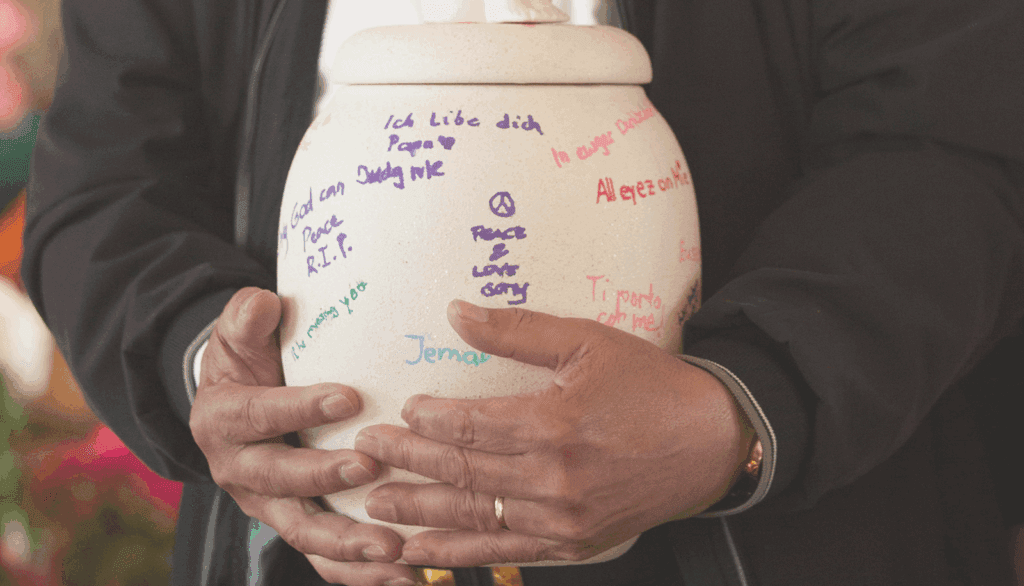
For some families, a concrete moment like the return of ashes after cremation also becomes an important stage of grief. When well-supported, this encounter can help bring meaning to what you are experiencing.

Key Factors Influencing the Grieving Process
The grieving process is deeply personal. It is shaped by a multitude of factors that make each story unique. In our approach, we take into account everything you are experiencing: your connection with the deceased person, your benchmarks, your resources, your strengths… and also your vulnerabilities.
What Influences the Experience of Grief
The relationship with the deceased
The stronger, more complex, or more significant the bond, the more intensely the loss can be felt. This could be a parent, a spouse, a child, a very close friend… The quality of the relationship (harmonious, conflicted, ambivalent) also plays a role in how grief manifests.
The circumstances of the loss
A sudden or violent death can amplify shock, denial, anger, or a sense of injustice. Conversely, an anticipated loss (illness, end of life) sometimes allows for a form of preparation, without diminishing the pain. Each context creates its own emotional challenges.
Social support
A present and benevolent support network can truly lighten the burden of grief. Family, friends, colleagues, support groups, or professionals offer spaces to talk, cry, and unburden oneself. Conversely, a lack of support or misunderstanding from those around can make the journey heavier.
Cultural and spiritual beliefs
Cultural, spiritual, or religious beliefs sometimes provide a framework for understanding death, feeling connected to something greater, and finding rituals and comfort. Everyone relies on what makes sense to them: prayers, rituals, symbols, family traditions…
At our company, we strive to embrace all these dimensions to offer you support that respects your reality.
The Importance of Support
The support of loved ones is often an essential pillar for navigating grief. Sometimes, words are lacking, but simple presence means a great deal.
Being there for someone grieving means:
offering active listening, without judgment, without trying to “fix” the pain;
allowing the other person to speak, repeat their story, cry, be silent;
offering a shoulder, a meal, a walk, a concrete gesture.
Sometimes, grieving individuals do not dare to ask for help or do not know how to express themselves. Our team can help you put words to what you are experiencing and identify the forms of support that would benefit you.
Support Groups
Support groups can offer a valuable space to feel less alone. There, you meet other people who are experiencing grief, with their words, their sorrows, their courage.
Sharing your experience with people who truly understand:
helps normalize your reactions (“I am not alone in feeling this”);
provides concrete ways to get through more difficult times;
creates a sense of belonging and mutual support.
We can direct you to grief support groups in Quebec or to other resources adapted to your situation.
Managing Emotions
Managing emotions during grief is an important part of healing. It is not about controlling what one feels, but about finding ways to embrace it.
Some avenues:
Express your feelings
Talk to someone trustworthy, write in a personal journal, consult a professional… Anything that allows you to externalize pain, anger, guilt, or fear helps to lighten the heart a little.Create rituals
Light a candle, take a walk on a significant date, create a photo album, write a letter to the deceased… Commemorative rituals help maintain a living connection with the departed person.Take care of yourself
Grief exhausts the body as much as the mind. Eat regularly, try to sleep, move a little, consult a professional if needed… These are small actions, but they support your ability to get through this period.Avoid total isolation
Even if the need for solitude is normal, remaining completely alone can increase suffering. Maintaining a few connections, even simple ones (a coffee, a call, a walk), can make a big difference.
Myths and Realities of Grief
There are many misconceptions about grief that can, at times, do more harm than good.
Grief is not a straight line nor a perfectly ordered sequence of stages. Even though we often speak of the stages of grief, each person progresses at their own pace, with back-and-forth movements, calmer moments, and more intense waves.
“Time heals all wounds.”
Time can soothe pain, but it doesn’t do everything. Healing often involves active self-work, encounters, support, and concrete actions to come to terms with the loss.“You must stay strong and not break down.”
Crying, talking, being vulnerable, asking for help… all of this is part of strength. One is not weak because they are suffering. On the contrary, acknowledging one’s pain is often an act of courage.
Our role is also to demystify grief, to offer you guidance, and to remind you that what you are feeling has meaning.
Conclusion
Navigating the grieving process is a personal and complex journey, but it is essential to recognize that every emotion felt is valid and part of healing. The stages of grief, although described as linear, are in reality interconnected and can be experienced in a non-linear fashion.
The support of loved ones, emotional management, and the creation of new rituals are crucial elements for moving forward. By understanding the different stages and arming oneself with compassion for oneself and for others, it is possible to navigate this period of pain and find a path toward acceptance and peace. The memory of loved ones can thus continue to live within us, offering strength and comfort throughout our life’s journey.
If you are more in a process of advance preparation, our article on simple and compassionate funeral prearrangements explains how to plan your wishes to lighten the burden of grief for your loved ones.
Ultimately, the important thing is not to “properly follow” the stages of grief, but to acknowledge what you are experiencing, surround yourself with support, and give yourself permission to go through this period in your own way.


ARE YOU EXPERIENCING GRIEF?
Free, confidential, and anonymous
365 days a year from 10 AM to 10 PM
Helpline for the Bereaved